
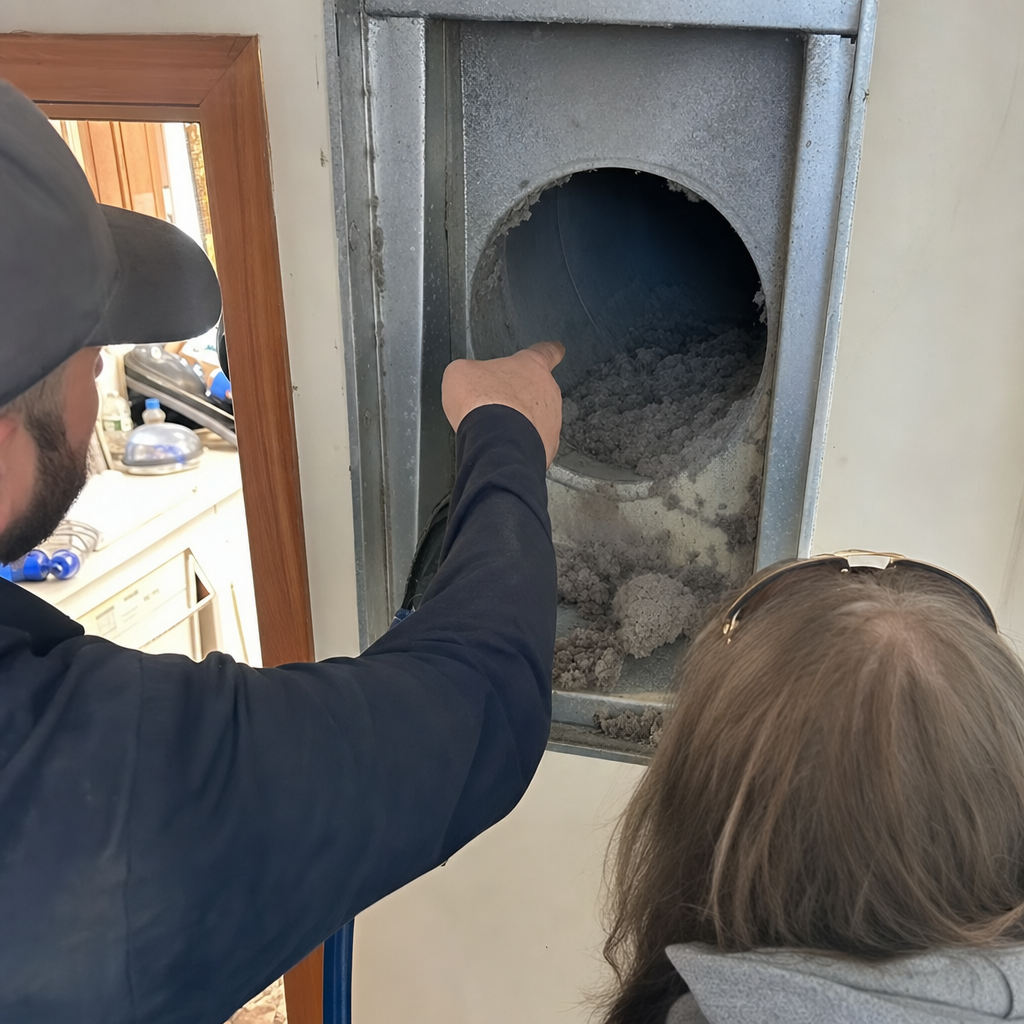
Signs You Need Dryer Vent Cleaning in Greeneville, TN — From Early Warnings to Fire Hazards
The most reliable signs you need dryer vent cleaning are clothes that come out warm but still damp after a normal cycle, a dryer exterior that’s hotter than usual to the touch, and a faint burning smell during the first few minutes of operation — all of which appear before the more commonly cited “two cycles to dry” failure point. In Greeneville’s older housing stock, where 18-foot vent runs with multiple elbows snake through original wall cavities, catching these early indicators matters more than it does in newer construction with straight, short exits. If you’re noticing any of these symptoms in your Greeneville home, call Guardian Air Duct Cleaning Greeneville at (888) 727-1051 — we’ll tell you honestly whether cleaning is the fix or if you’re looking at a deeper airflow problem.

Why Greeneville Homes Hide Vent Problems Longer Than Newer Construction
By the time your dryer is taking two cycles to dry a load, the lint is already compacted far enough to be a fire risk. In a pre-WWII or 1950s Greeneville home with an 18-foot vent run through interior walls, you want to catch this earlier than that.
Greeneville sits in a low valley basin ringed by Appalachian ridges where cold-air pooling and the Nolichucky River watershed produce near-daily fog and among the highest sustained ambient humidity levels in northeast Tennessee. That moisture doesn’t just affect your HVAC ductwork — it changes how lint behaves inside your dryer vent. In drier ridge-top communities like Johnson City or Kingsport, lint stays loose and powdery, often blowing through with a basic reverse-airflow cleaning. In Greeneville, that same lint absorbs ambient moisture through exterior wall cavities and crawl spaces, clumping into dense, damp wads that adhere to elbow joints and corrugated sections. Damp-clumped lint blocks faster and is harder to clear with reverse-airflow-only methods.
Much of Greeneville’s residential stock was built during the 1950s–1970s manufacturing boom, when Magnavox, Uniroyal, and related suppliers drew a large working-class population. Builders of that era prioritized cost and speed over optimal vent routing. We’ve crawled through enough Greene County crawlspaces to recognize the pattern: a 4-inch vent line with two or three 90-degree elbows, a 12-to-18-foot horizontal run through an exterior wall, and a termination point that’s either at ground level or tucked under a deck where it stays damp year-round. Each elbow is a compaction point. The lint doesn’t distribute evenly — it piles at the bends, creating a dense plug while the straight sections still carry some airflow. That’s why a homeowner can feel “some” air at the exterior flap and assume the vent is “basically clear” when it’s actually dangerously obstructed at the second elbow, ten feet inside the wall.
Thomas Hernandez, our Owner and Lead Technician, grew up near the Nolichucky River corridor on the south end of Greeneville and has spent more than two decades working in and around Greene County homes. He’s cleared vents where the lint compaction was so dense at the second elbow that a rotary brush was the only tool that reached it — the kind of blockage a DIY kit with a 6-foot flexible rod simply cannot touch. That’s the difference between professional-grade equipment and the consumer-grade solutions that leave homeowners with a false sense of security.
The Full Warning Spectrum: What to Watch For, From Subtle to Critical
Most online guides list the same three late-stage symptoms: long dry times, a hot exterior, and a burning smell. They’re not wrong, but they’re describing a problem that’s already mature. Here’s what we’ve learned across 20 years of duct work — the earlier signals that let you act before the hazard materializes.
Early-Stage Indicators (Catch These First)
- Clothes warm but damp after a normal cycle. Not wet — damp. The heating element is working, but moist air isn’t evacuating fast enough. In Greeneville’s humid valley environment, this moisture lingers longer than it would in drier climates, so the symptom appears sooner and more consistently.
- Dryer exterior warmer than usual to the touch. Run your hand along the side panel mid-cycle. It should be warm, not hot enough to make you pull away. A noticeable temperature jump means exhaust air is backing up against the drum seal and heating the cabinet instead of exiting the vent.
- Faint burning smell during the first 3–5 minutes of operation. This is lint contacting the heating element or overheating the motor. It often dissipates as the cycle continues, which leads homeowners to dismiss it. Don’t. In a vent with multiple elbows, that smell is lint smoldering at a restriction point — and smoldering can precede ignition.
- Exterior termination flap behavior changes. The flap should swing fully open during operation and settle completely closed when idle. A flap that stays partially open is a pest and moisture entry point; one that barely opens indicates significant restriction upstream. We’ve found Greeneville vents where the flap appeared to move normally but was actually bypassing a complete blockage — the small amount of air leaking around the lint dam was enough to flutter the flap without indicating real throughput.
Mid-Stage Indicators (Action Needed Soon)
- One extra 10–15 minutes needed per load. The dryer compensates with longer run times. Your utility bill climbs before you notice the pattern.
- Lint accumulating around the interior door seal. Airflow reversal is pushing lint back into the drum instead of out the vent.
- Humidity spike in the laundry room. Moist air is escaping into the room through gaps in the duct connections, often at elbow joints that have separated under vibration.
Late-Stage Indicators (Immediate Professional Attention)
- Two full cycles to dry a standard cotton load. The vent is substantially blocked. Fire risk is elevated.
- Dryer shuts off mid-cycle on thermal overload. The high-limit thermostat is protecting the machine from overheating — and signaling that the vent is creating a dangerous condition.
- Visible smoke or strong burning odor. Stop operation immediately. This is an active fire risk.
- Exterior vent shows no airflow during operation. Complete blockage, likely at a distant elbow or where the vent terminates in a moisture-compromised location.
What the Exterior Flap Tells You — And What It Hides
The exterior termination flap is the only visible checkpoint most homeowners have, but it’s also the most misread. Here’s how to interpret what you see, based on what we’ve found in Greeneville homes.
Flap opens fully, closes fully: Best-case scenario. Airflow is adequate, though this doesn’t confirm the vent is clean — only that it’s not completely blocked.
Flap opens partially or sluggishly: Restriction upstream. Could be lint compaction at an elbow, or — in Greeneville’s environment — damp lint clumped at a low point in the run. We’ve seen partial openings that masked 70% blockages because a small channel remained open around the compacted material.
Flap barely moves or doesn’t open: Severe blockage. Do not continue operating the dryer.
Flap stays open when dryer is off: Missing or damaged damper, or lint buildup preventing closure. This creates a direct path for humid valley air, insects, and rodents to enter the vent. In Greeneville’s agricultural fringe, where field dust — tobacco, hay, and row-crop particulate — blows through return-air leaks during late-summer and fall harvests, an open flap is an invitation for additional contamination that compounds the lint problem.
The critical detail competitors miss: a moving flap does not mean a clear vent. In long multi-elbow runs common to Greeneville’s downtown historic and postwar housing stock, lint compaction can be severe at the second or third elbow while the final straight section still carries enough air to move the flap. We’ve pulled out compacted lint masses that started 12 feet inside the wall, where no homeowner’s inspection can reach. That’s why we use Rotobrush and Nikro rotary systems with camera verification — we find what others leave behind, and we prove it with footage you can see.
Greeneville’s Humidity Problem: Why Lint Blocks Faster Here
The valley-bowl geography around Greeneville creates frequent temperature inversions and morning fog that lingers into midday for much of fall and winter. Crawl-space and basement duct runs in this environment are exposed to sustained near-saturation air for extended stretches each year. Dryer vents routed through these same spaces experience the same conditions.
Here’s the mechanism: lint is hydrophilic. It absorbs moisture from humid air passing through the vent even when the dryer isn’t running. Over days of Greeneville fog and drizzle, that lint swells and mats. When the dryer does run, the mat doesn’t break up and blow through — it hardens at elbow points where airflow velocity drops. The result is a blockage that forms faster and clears harder than in drier climates.
This is why we don’t recommend reverse-airflow-only cleaning for Greeneville’s older homes. The compressed, dampened lint at elbow joints often requires mechanical agitation — a rotary brush system — to break loose. Our Nikro and Rotobrush equipment, the same tools used by commercial and industrial contractors, deploys brushes sized to the duct diameter with torque sufficient to dislodge compacted material without damaging original galvanized venting. We’ve tried the alternatives. They don’t work consistently in this environment.
Professional Dryer Vent Cleaning in Greeneville: What It Costs and What You Get
When early signs appear, the question becomes whether to attempt DIY cleaning or call a professional. For straight, short vents in newer construction, a homeowner kit with a flexible rod and brush can maintain reasonable cleanliness between professional services. For Greeneville’s typical vent configurations — long runs, multiple elbows, original wall cavities — we see the limitations of that approach weekly.
| Service Level | What’s Included | Typical Range in Greeneville |
|---|---|---|
| Standard dryer vent cleaning | Full vent run from dryer connection to exterior termination, rotary brush agitation with vacuum extraction, airflow verification | $149–$219 |
| Extended/complex run cleaning | Runs over 15 feet or with 3+ elbows, camera inspection, elbow-point disassembly if accessible | $219–$289 |
| Vent repair or rerouting | Replacement of damaged sections, elbow reconfiguration, termination relocation for better exposure | $289–$450+ (project-dependent) |
These ranges reflect Greeneville’s market specifically. We’re not a franchise with national pricing sheets — Thomas handles your job personally, and the quote you receive is based on what we find in your actual home, not a flat rate designed to cover overhead in forty cities.
What distinguishes our Dryer Vent Cleaning service is the same thing that distinguishes all our work: professional-grade equipment, residential prices, and a technician with 20 years of experience who’s actually doing the work, not supervising a rotating crew. We also inspect the full system while we’re there — duct connections, backdraft damper function, and whether your vent termination location is contributing to the moisture problem. Clean ducts are only part of the answer; if your vent exits under a deck where it stays damp year-round, we’ll tell you that too.
How Often Should Greeneville Homeowners Clean Dryer Vents?
For standard household use — a family of 3–4 doing 5–7 loads weekly — we recommend annual inspection and cleaning every 12–18 months. In Greeneville’s humidity, that interval shortens if any of these apply: your vent run exceeds 12 feet, you have more than two elbows, your termination is at or below grade, or you dry a high volume of lint-generating fabrics (towels, fleece, pet bedding).
Homes on lower-elevation streets near the Nolichucky River bottomlands face additional exposure. The sustained ambient moisture in those areas, combined with agricultural field dust during harvest season, creates a faster accumulation pattern. We’ve serviced homes in these areas where 10 months of use produced compaction equivalent to 18 months in drier, higher-elevation parts of Greene County.
If I wouldn’t tell my own family they need it, I’m not going to tell you. Some vents we inspect are genuinely clear and don’t need service. We’ll show you the camera footage and send you on your way — no charge for the honesty. That’s how we’ve maintained 113 verified reviews at a 4.7 rating across two decades: by being straight about what actually needs doing.
FAQs
A partially clogged vent and a vent needing preventive cleaning exist on the same spectrum — the difference is severity and urgency. If your dryer still dries in one cycle but shows early signs like warm-but-damp clothes or a slightly hotter cabinet, you’re in the preventive zone. If you’re at two cycles, burning smells, or thermal shutdowns, you’re in the clogged-and-hazardous zone. In either case, a professional inspection with camera verification removes the guesswork. Call Guardian Air Duct Cleaning Greeneville at (888) 727-1051 — estimates are free, and we’ll show you exactly what we’re seeing inside your vent.
For a straight, short vent in newer construction, a $30 homeowner kit may suffice for maintenance between professional cleanings. For Greeneville’s typical long, multi-elbow runs through original wall cavities, DIY kits rarely reach the compaction points where blockages actually form — usually at the second or third elbow, 10–15 feet inside the wall. We’ve been called after DIY attempts where the homeowner cleared the first 6 feet and assumed the job was done, while a dense lint mass remained at the distant elbow. The cost of a missed blockage is far higher than professional cleaning: elevated utility bills, premature dryer failure, or fire damage. Call (888) 727-1051 for an exact quote — our standard cleaning starts at $149, and you’ll know the full scope before we begin.
Yes — lint is highly combustible, and restricted airflow causes the dryer to overheat. The U.S. Fire Administration reports thousands of dryer fires annually, with failure to clean as the leading cause. In Greeneville’s older housing stock, the risk profile is elevated: longer vent runs with multiple elbows create more lint accumulation points, and the valley’s high humidity causes lint to clump and compact denser than in drier climates. A smoldering lint mass at a blocked elbow can ignite with little warning. If you smell burning during dryer operation, stop using it immediately and call for inspection. Guardian Air Duct Cleaning Greeneville can assess your fire risk and clear the blockage — (888) 727-1051.
Most standard cleanings take 45–90 minutes, depending on vent length, accessibility, and blockage severity. Extended runs with multiple elbows or concealed access points in Greeneville’s older homes may require 90–120 minutes, including camera verification and airflow testing. We don’t rush — Thomas handles your job personally, and we’ll take the time to show you what we found and why it mattered. Schedule at (888) 727-1051; same-day appointments are often available for urgent situations.
When to Call Guardian Air Duct Cleaning Greeneville
If you’re seeing early signs — warm damp clothes, a hotter-than-usual cabinet, a fleeting burning smell — you’re in the window where cleaning prevents hazard. If you’re at the late-stage symptoms, stop operating the dryer and call immediately. We’ve spent two decades in Greene County homes, from downtown historic properties to postwar manufacturing-boom neighborhoods to newer construction on the agricultural fringe. We know the vent configurations, the humidity complications, and the difference between a vent that needs cleaning and one that needs rerouting.
Guardian Air Duct Cleaning Greeneville offers no-pressure assessments throughout Greeneville and surrounding Greene County. Thomas Hernandez, Owner and Lead Technician, brings 20 years of hands-on experience and professional-grade Rotobrush and Nikro equipment to every job. Call (888) 727-1051 for a free estimate — we’ll tell you honestly what you’re dealing with, and we’ll show you the proof.
Written by Thomas Hernandez, Owner & Lead Technician at Guardian Air Duct Cleaning Greeneville, serving Greeneville, TN.