
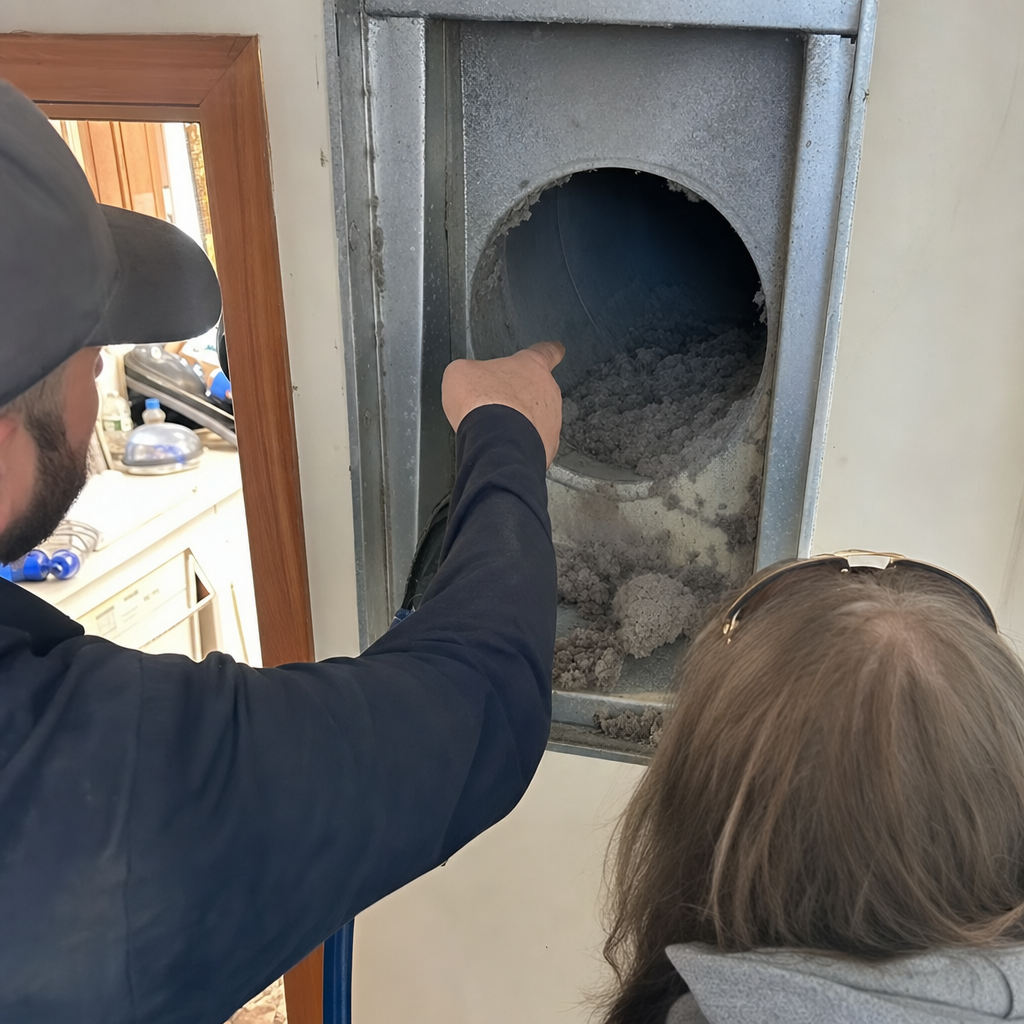
Is Air Duct Cleaning Worth It in Greeneville, TN? Yes — If Your Home Matches the Conditions Our Valley Creates
Air duct cleaning is worth it in Greeneville when you have visible mold, vermin evidence, or debris restricting airflow — three conditions the EPA itself flags as definitive reasons to clean. Because Greeneville’s valley-bowl geography traps humidity and cold air against the Appalachian ridges, those conditions develop here far more often than in drier ridge-top markets like Johnson City or Kingsport just miles away. If you’re noticing musty airflow when the heat kicks on, seeing dark staining around vent registers, or your home was built during the 1950s–1970s manufacturing boom with original ductwork still in place, the question isn’t whether cleaning has value — it’s whether a qualified operator with proper containment equipment is doing the work. Call (888) 727-1051 and Thomas will tell you straight if your system needs it.

Why the EPA’s Position Means Something Different Here
The Environmental Protection Agency’s frequently quoted stance — that duct cleaning has not been proven to prevent health problems in all cases — was developed from studies conducted largely in arid and semi-arid climates. The agency’s own guidance, however, identifies three specific situations where cleaning is definitively warranted: visible mold growth inside hard surface ducts, evidence of vermin infestation, and substantial debris that actually restricts airflow.
In Greeneville, we hit condition one with depressing regularity.
Our town sits in a low valley basin where the Nolichucky River watershed and surrounding Appalachian ridges produce near-daily fog and among the highest sustained ambient humidity levels in northeast Tennessee. Cold-air pooling in fall and winter keeps crawlspace and basement duct runs bathed in near-saturated air for weeks at a stretch. That moisture doesn’t stay outside — it migrates through return-air pathways, condenses on cooler duct surfaces, and creates the precise conditions for mold colonization that the EPA explicitly flags.
We’ve opened duct systems in homes near the river bottomlands and along the agricultural fringe where the interior fiberglass lining had active microbial growth the homeowner never suspected because the vents themselves looked clean. The mold was growing two feet inside the trunk line, invisible from the living room, fed by humidity that ridge-top homes simply don’t experience.
This is why we tell Greeneville homeowners: the national debate about whether duct cleaning “prevents” health problems is the wrong question here. The right question is whether your specific duct system, in this specific geography, has developed the contamination conditions that make cleaning not just worth it, but necessary.
The Housing Stock Honesty Check: What Era Was Your Home Built?
Much of Greeneville’s residential construction dates to the 1950s through 1970s, when Magnavox, Uniroyal, and their supplier networks drew thousands of workers and built housing fast. That era’s ductwork tells a story that changes the “worth it” calculation entirely.
Three material realities we encounter weekly:
- Galvanized-steel trunk lines from this period corrode faster than expected under sustained humidity. We’ve pulled sections where the interior zinc coating has failed completely, leaving raw steel that sheds rust particulate into airflow.
- Early fiberglass duct board — common in 1960s and 1970s construction — degrades structurally when humidity cycles repeatedly through saturation and partial drying. The binder resins break down, fibers release into the airstream, and the board itself becomes a contamination source rather than a clean conduit.
- Pre-WWII gravity-furnace conversions in downtown and adjacent historic blocks left oversized duct cavities never engineered for forced-air velocity. Decades of debris accumulate in dead zones where modern airflow patterns don’t reach, creating reservoirs of particulate that re-entrain during system cycling.
A homeowner with 1970s fiberglass duct board experiencing humidity-driven binder degradation isn’t facing a “maybe” situation. They’re facing a material failure that cleaning can address — and that duct repair and sealing may need to follow. Thomas has crawled through enough of these systems to spot the difference between surface debris and structural breakdown within the first few minutes of inspection.
That’s the distinction that gets lost in generic “is it worth it” articles written for national audiences. For a 1965 ranch on the south end with original duct board, the question isn’t abstract. It’s whether the degradation inside those ducts is now part of your air quality problem.
Seasonal Contamination Greeneville Technicians See That Others Don’t
Here’s something no EPA study from Arizona or Colorado accounts for: the agricultural particulate that enters Greeneville homes during late summer and fall harvest.
Homes on lower-elevation streets near the Nolichucky River bottomlands and along the surrounding Greene County agricultural fringe pull in field dust through return-air leaks — tobacco leaf fragment, hay particulate, row-crop dust — during the active harvest season. This isn’t generic household dust. It’s organic material with higher moisture content and faster microbial growth potential than typical residential particulate.
We’ve cleaned systems where the return trunk was lined with a fine layer of tobacco dust that had absorbed enough humidity to support mold growth on the duct surface itself. Technicians working hillside markets like Johnson City don’t encounter this pattern because the elevation and exposure differences change both the agricultural activity and the moisture dynamics.
The “worth it” question for these homeowners isn’t about routine maintenance philosophy. It’s about whether they want harvest-season agricultural particulate cycling through their HVAC system for months after the fields are done.
Who Does the Work Matters More Than Whether You Do It
This is where we get direct with you, because Thomas has seen the aftermath of bad duct cleaning and it’s not pretty.
A shop-vac-and-brush operation that dislodges debris without source-removal containment can temporarily worsen your air quality significantly. Agitating mold, rodent droppings, or fine particulate inside a duct system and then failing to extract it under negative pressure simply redistributes contamination through your home during the next heating or cooling cycle.
The “worth it” calculation collapses entirely if the operator lacks:
- Negative-pressure containment — the duct system is placed under vacuum during agitation so dislodged debris is extracted at the source, not pushed into living spaces
- Mechanical agitation matched to duct material — Rotobrush systems for flexible ductwork, specialized whipping tools for rigid metal, gentle but thorough contact methods for aging fiberglass board
- Post-cleaning verification — visual inspection through access ports, airflow measurement where appropriate, and honest reporting of what was found versus what was expected
Guardian deploys Rotobrush and Nikro equipment — the same professional-grade systems used in commercial and industrial applications — with Abatement Technologies air quality tools for post-cleaning assessment. Thomas handles your job personally, which means the person with 20 years of duct work experience is the one deciding which tool, which pressure setting, and which access strategy fits your specific system.
We’ve had Greeneville homeowners call us after a budget cleaning left them with worse dust and mustiness than before. In those cases, the cleaning wasn’t “not worth it” — the operator wasn’t worth it. The equipment and technique matter enormously.
What “Worth It” Actually Costs in Greeneville
We don’t quote exact prices without seeing your system, because square footage, duct configuration, and contamination level vary too much. But Greeneville homeowners should understand the general landscape so they can evaluate bids intelligently.
| Service Scope | Typical Range | What Drives Cost |
|---|---|---|
| Standard residential duct cleaning (single system, 1,500–2,500 sq ft) | $350–$550 | Number of vents, accessibility, contamination level |
| Older home with galvanized steel or fiberglass duct board requiring careful handling | $450–$700 | Material fragility, additional access cuts, slower work pace |
| System with confirmed mold requiring cleaning plus sanitizing | $600–$900 | EPA-registered antimicrobial application, extended contact time, post-treatment verification |
| Duct repair and sealing added to cleaning | $200–$500 additional | Sealant type (mastic vs. aerosol), linear feet of accessible ductwork, leak severity |
The low end of that standard range typically covers homes built after 1990 with accessible ductwork and routine dust accumulation. The higher end reflects what we regularly find in Greeneville’s 1950s–1970s stock: corrosion, insulation breakdown, and the careful handling required to clean without causing further damage.
We also integrate Aprilaire filtration and Honeywell air quality products where the root problem isn’t just dirty ducts but inadequate system-wide air cleaning. “Clean ducts are only part of the answer” — that’s been our experience across two decades of Greeneville homes.
Common Local Scenarios: When We Tell Homeowners Yes, No, or Not Yet
After 20 years in Greene County, Thomas has developed a pretty reliable pattern recognition. Here are the situations we encounter most often, and what we actually tell people:
“We just bought a 1968 ranch near the river and the inspector noted ‘dirty ducts.'”
We almost always recommend inspection and likely cleaning. Homes from this era with original ductwork near the Nolichucky bottomlands have usually experienced enough humidity cycling that surface debris is the least of it. We’re looking for fiberglass delamination, rust scale, and the organic dust loading that comes with agricultural proximity. The inspection itself tells us whether cleaning is sufficient or whether Air Duct Cleaning needs to be paired with repair and sealing.
“My allergies are worse since we moved here from Kingsport.”
We ask about the home’s elevation and age first. If you’re in a valley-bottom location with pre-1980 ductwork, the humidity differential from your previous home may have activated dormant contamination or accelerated material breakdown. We inspect before we commit to cleaning — because if the issue is actually duct leakage pulling in crawlspace air, cleaning alone won’t solve it. Thomas will tell you straight if the problem is the ducts, the system design, or both.
“The vents look clean and we change our filter religiously.”
Visible vent cleanliness doesn’t indicate trunk line condition. We’ve found substantial contamination two feet past registers that looked spotless. That said, if your home is post-1990 construction on higher ground with no moisture issues, we may tell you to wait and monitor. If I wouldn’t tell my own family they need it, I’m not going to tell you.
“We had a water leak in the crawlspace last winter.”
This is almost always a yes. Even “minor” crawlspace moisture events in Greeneville’s humidity mean sustained near-saturation conditions that promote mold growth in duct insulation and on metal surfaces. We inspect for visible growth, test insulation integrity, and recommend cleaning plus sanitizing with Abatement Technologies protocols when contamination is confirmed.
How to Tell If Your System Shows the Warning Signs
Greeneville homeowners can do some basic observation before calling, though we don’t recommend DIY duct intrusion — the sheet metal edges are sharp, fiberglass insulation is irritating, and disturbing mold without containment is genuinely hazardous.
What you can safely check:
- Remove a floor or wall register and shine a flashlight into the duct boot (the short section connecting register to main trunk). Look for dark staining, fuzzy growth, or debris accumulation more than a thin dust layer.
- Note whether airflow seems uneven room-to-room, which can indicate trunk line restriction.
- Pay attention to musty or earthy odors when the system first cycles on, especially after it’s been off for several hours.
- Check your filter replacement schedule against actual condition — if filters clog faster than expected, your return ducts may be pulling in excess particulate through leaks.
If you see dark staining that wipes away as powdery residue, or if the odor is distinctly musty rather than just “stale,” that’s worth a professional look. Call (888) 727-1051 and we’ll schedule an assessment with no pressure to commit to service.
FAQs
It depends on your home’s age, location, and what inspection reveals. In Greeneville, we’ve found active mold growth two feet inside trunk lines where registers looked completely clean, particularly in pre-1980 homes with original fiberglass duct board. The valley’s sustained humidity means contamination often develops out of sight. We recommend inspection first — Thomas will show you what the camera sees and tell you honestly whether cleaning is warranted or premature.
Most Greeneville homeowners pay between $350 and $550 for standard residential cleaning, with older homes or confirmed mold situations running $450 to $900 depending on material condition and required sanitizing. We don’t quote exact prices without seeing your system because duct configuration and contamination level vary significantly, especially with the 1950s–1970s housing stock common here. Call (888) 727-1051 for a free, no-pressure assessment and written estimate.
Yes — if done without proper negative-pressure containment and source removal. Agitating debris without extracting it under vacuum redistributes contamination through your home. This is why we use Rotobrush and Nikro professional-grade systems with full containment, and why Thomas handles every job personally rather than sending rotating subcontractors who may not recognize when a system requires gentler handling. The operator’s technique matters more than the fact of cleaning itself.
There’s no universal schedule — the EPA doesn’t recommend routine cleaning on a fixed interval. In Greeneville’s humidity-driven environment, we typically see meaningful accumulation every 5 to 7 years in homes with good filtration and no moisture events, but post-water-intrusion situations or homes with original 1960s–1970s duct board may need attention sooner. We find what others leave behind because we inspect thoroughly before recommending anything, and we’ll tell you if your system genuinely doesn’t need service yet.
When You’re Ready for an Honest Assessment
If you’d rather have it looked at, Guardian Air Duct Cleaning Greeneville offers a no-pressure assessment in Greeneville — call (888) 727-1051. Thomas Hernandez, Owner & Lead Technician, brings 20 years of hands-on experience to every inspection, and he’ll tell you straight whether your system needs cleaning, sealing, sanitizing, or simply continued monitoring. Two decades of duct work in Greene County means we’ve seen what this valley’s humidity does to every type of system, and we don’t sell service your home doesn’t need.
Written by Thomas Hernandez, Owner & Lead Technician at Guardian Air Duct Cleaning Greeneville, serving Greeneville, TN.