
Rotobrush Air Duct Cleaning in Greeneville: A Homeowner’s Guide
Rotobrush air duct cleaning in Greeneville typically runs $300–$600 for a standard residential system and uses a spinning brush head with simultaneous vacuum suction to dislodge and remove debris in a single pass. The key difference from traditional methods isn’t the machine itself—it’s whether your technician pairs it with proper negative air pressure at the main trunk and follows up with camera verification. If you’d rather not sort through contractor claims yourself, call Guardian Air Duct Cleaning Greeneville at (888) 727-1051 for a free estimate and we’ll show you exactly what your system needs.
Here’s the mistake we see most often: a homeowner hires a company that advertises “Rotobrush cleaning,” pays standard market rate, and ends up with ducts that look marginally better at the register but still blow dust two weeks later. The contractor handed them a brochure with the Rotobrush logo, ran the machine for an hour, and called it done. The homeowner had no way to evaluate the work because nobody showed them before-and-after footage from deep in the system. We’ve been called in behind these jobs more times than we can count across Greeneville and the surrounding hills.
What Rotobrush Actually Does Inside Your Ducts
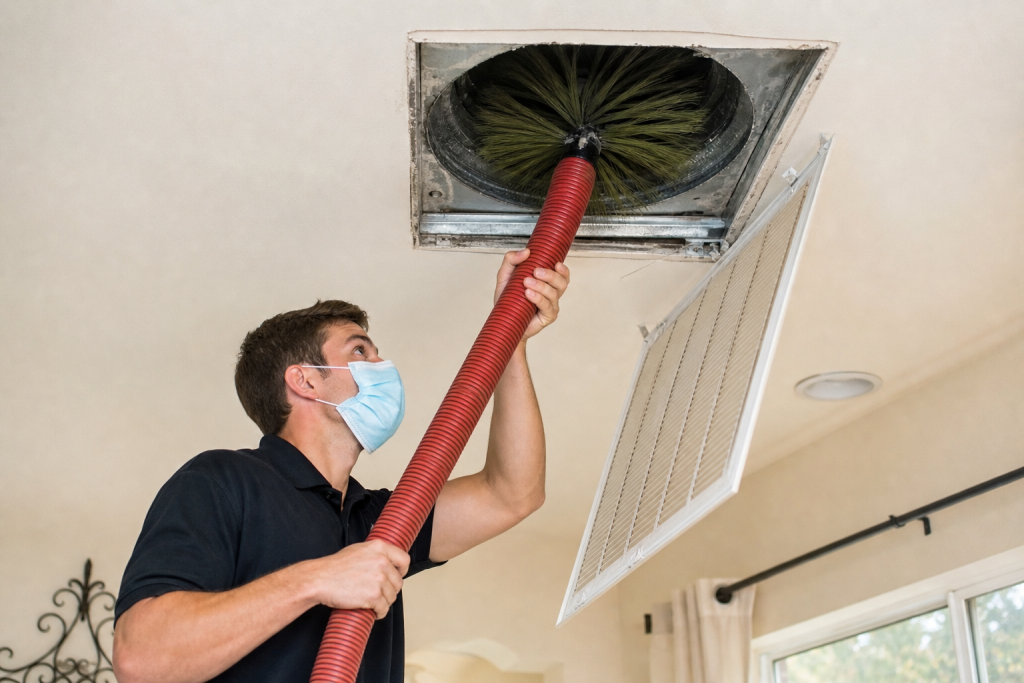
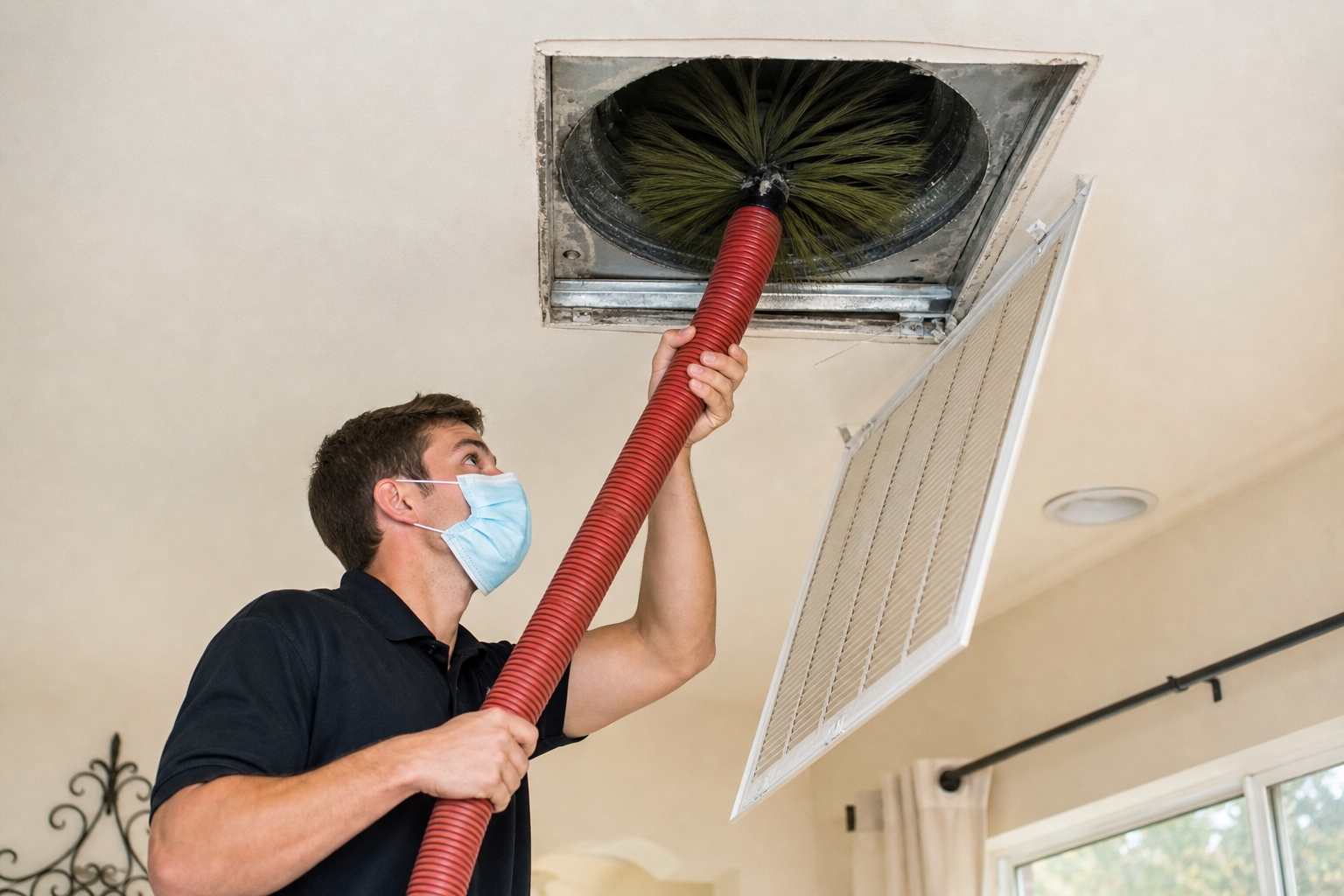
Rotobrush systems combine two actions that traditional cleaning often separates: mechanical agitation and debris extraction happen simultaneously through a single cable-driven assembly. A rotating brush head—typically 8 to 12 inches in diameter depending on duct size—spins at roughly 450 RPM while a vacuum port directly behind it draws dislodged material into a HEPA-filtered collection chamber.
This matters because traditional “agitate-then-extract” methods use separate tools: a skipper ball or whip first knocks debris loose, then a vacuum hose or negative air machine removes it. The gap between these steps lets settled debris redistribute before extraction, especially in the flexible ductwork common in Greeneville homes built from the 1980s through the mid-2000s.
Where Rotobrush excels:
- Flexible duct systems: The brush conforms to corrugated interiors better than rigid skipper balls, actually contacting the full surface area.
- Residential trunk-and-branch layouts: The compact cable assembly navigates 90-degree turns and reducer fittings that larger negative-air hoses struggle to clear.
- Light-to-moderate accumulation: Routine maintenance cleanings where debris hasn’t formed hardened layers.
Where it has limitations:
- Heavily compacted debris: Years of layered dust, construction residue, or rodent nesting material can jam the brush or simply polish the surface without breaking the bond.
- Main trunk lines in large systems: The brush diameter maxes out around 18 inches; commercial-sized trunks need negative air methods with larger access points.
- Wet or adhesive contamination: Mold with moisture content, grease from kitchen vents, or pest droppings with biological adhesion require different protocols entirely.
In our experience across Greeneville—from the older homes near Andrew Johnson Highway to newer construction in the Oak Grove area—the Rotobrush handles roughly 70% of residential systems effectively when used as part of a complete protocol. The other 30% need pre-treatment, alternative agitation methods, or in rare cases, duct replacement.
Why Negative Air Pressure Makes or Breaks the Results
This is the detail most competitors gloss over, and it’s where homeowners get shortchanged. Rotobrush’s simultaneous brush-and-vacuum action works at the point of contact, but it doesn’t create sufficient airflow to capture debris that escapes the immediate vacuum zone. Without supplemental negative air pressure at the main trunk line, dislodged particles simply float downstream and resettle.
Think of it like this: the Rotobrush is a spot cleaner. Negative air pressure is the whole-room ventilation that carries everything out. We use a Nikro portable negative air machine—rated for 2,000 CFM—connected to the main trunk through a sealed access point while the Rotobrush works each branch line. This creates directional airflow: debris disturbed by the brush gets drawn toward the trunk and captured by the HEPA-filtered negative air unit, not pushed toward registers in other rooms.
We’ve inspected systems in Greeneville where a “Rotobrush cleaning” left the branch lines polished but the main trunk loaded with debris that simply migrated during the process. The homeowner smelled dust for weeks. When we connected our negative air setup and re-cleaned, the difference on camera was stark—same machine, completely different outcome because of the protocol around it.
What to ask your contractor: “Are you running negative air at the trunk while the Rotobrush works the branches?” If they hesitate or describe the Rotobrush vacuum as sufficient on its own, you’re not getting a complete cleaning.
What Homeowners Should Demand to See
Camera verification isn’t optional—it’s the only way to confirm results in a system you can’t visually inspect. We carry a 120-degree borescope with LED illumination and record footage at two critical points: the furthest register from the air handler (where airflow is weakest and debris accumulates most) and a midpoint access in the main trunk.
Here’s what proper documentation looks like:
- Pre-cleaning footage showing debris type, accumulation depth, and any structural issues like disconnected flex duct or corrosion.
- Real-time cleaning footage when accessible, demonstrating brush contact and debris removal.
- Post-cleaning footage from the identical locations, with timestamps, showing bare metal or clean flex interior.
We pulled one job in a garage over in the Forest Hills neighborhood last month where the previous contractor’s “cleaning” had actually compacted debris against a sagging flex duct section. The homeowner had paid $400, received no footage, and called us six weeks later because their utility bills spiked. The brush had polished the accessible areas and packed the obstruction tighter in the sag. We showed them the camera feed, cut in an access panel, removed the blockage by hand, and repaired the support. Two decades of duct work teaches you that what you can’t see will cost someone money eventually.
If a contractor won’t show you footage—or only shows register-level photos without trunk verification—you’re buying trust, not results.
How We Use Rotobrush Within a Complete Cleaning Protocol
At Guardian Air Duct Cleaning Greeneville home, Rotobrush is one tool in a sequence, not the entire service. Thomas handles your job personally, and our protocol for a standard residential system in Greeneville runs like this:
- System assessment: Visual inspection of registers, return grilles, and accessible trunk sections; airflow measurement at each register; borescope documentation of furthest runs.
- Negative air setup: Nikro HEPA negative air machine connected to main trunk with sealed access; this runs continuously through all subsequent steps.
- Register and grille cleaning: Removed, washed, and sanitized off-site if heavily soiled.
- Rotobrush branch cleaning: Each supply and return branch worked from register toward trunk, with brush size matched to duct diameter.
- Main trunk agitation: For trunks larger than Rotobrush capacity, we switch to a skipper ball or compressed-air whip with the negative air machine still drawing.
- Air handler and coil inspection: Blower compartment, evaporator coil, and drain pan evaluated; HVAC Cleaning in Greeneville scheduled separately if needed.
- Post-cleaning verification: Borescope footage at original inspection points; airflow remeasurement; filter replacement if homeowner supplies or we recommend an upgrade.
- Sanitizing option: For homes with allergy concerns, recent water damage, or pest history, we apply an EPA-registered sanitizer through the system using an Abatement Technologies fogger.
This sequence takes 3–5 hours for a typical 2,000-square-foot Greeneville home. Competitors advertising “whole-house duct cleaning in 90 minutes” are skipping steps—usually the negative air setup, the trunk work, or the verification footage. Professional-grade equipment, residential prices only holds up when you’re actually using the equipment to its capacity.
Clean ducts are only part of the answer. We find what others leave behind because we inspect, measure, and document rather than assume the brush got everything.
When to Call a Pro vs. Maintain Yourself
Homeowners can and should replace HVAC filters on schedule—typically every 60–90 days for standard 1-inch pleated filters in Greeneville’s mixed pollen and agricultural dust environment. You can also vacuum register grilles and keep return pathways clear of furniture and debris.
Call a professional when:
- Visible dust emission from registers when the system cycles on
- Uneven heating or cooling between rooms (possible blockage or leakage)
- Musty or stale odors persist after filter changes
- Recent renovation or construction work
- System hasn’t been cleaned in 5+ years
- Allergy symptoms worsen seasonally independent of outdoor conditions
Related services in Greeneville: if your dryer takes multiple cycles or the exterior vent flap doesn’t open fully during operation, you likely need Dryer Vent Cleaning in Greeneville—a separate fire-safety service that many homeowners overlook.
The Bottom Line
Rotobrush is a capable tool for Greeneville residential duct cleaning, but the machine alone doesn’t determine your results. What matters is the protocol surrounding it: negative air pressure at the trunk, proper brush sizing for your duct diameters, camera verification from deep in the system, and a technician experienced enough to recognize when Rotobrush isn’t the right tool for a specific section.
Key takeaways:
- Rotobrush brush-and-vacuum action works best in flexible duct and light-to-moderate accumulation
- Without negative air pressure at the main trunk, debris redistributes rather than exits
- Demand timestamped before-and-after camera footage from the furthest register and main trunk
- Complete residential cleaning takes 3–5 hours; 90-minute jobs skip critical steps
- Owner-operator experience matters more than brand names on the equipment
If you’re in Greeneville and want to know what your system actually needs—not a generic sales pitch—Guardian Air Duct Cleaning Greeneville offers free estimates. Thomas Hernandez, Owner and Lead Technician, handles every job personally with 20 years in the trade. Call (888) 727-1051 to schedule your inspection and camera assessment.
Frequently Asked Questions
Most Greeneville homeowners pay between $300 and $600 for a complete Rotobrush-based duct cleaning on a standard residential system up to 2,500 square feet. Larger homes, systems with multiple HVAC units, or jobs requiring access panel installation run higher. We provide exact quotes after a free in-home assessment—call (888) 727-1051 to schedule yours.
Neither is universally superior; they’re suited to different situations. Rotobrush excels in flexible ductwork and residential branch lines with moderate debris. Negative air methods with skipper balls or compressed-air whips handle larger trunks and heavy compaction better. We use both—Rotobrush for branches, negative air for trunks—because the combination produces cleaner results than either method alone.
A thorough cleaning of a typical Greeneville home takes 3 to 5 hours, including setup, negative air connection, branch-by-branch Rotobrush work, trunk cleaning, and camera verification. Any contractor promising completion in under 2 hours is likely skipping the trunk work, omitting negative air, or not verifying results—meaning you’ll pay again sooner than necessary.
When operated correctly with properly sized brush heads, Rotobrush systems are safe for flexible duct. The risk comes from oversized brushes forced through undersized ducts, or excessive RPM in fragile older flex. This is why experience matters—Thomas Hernandez evaluates duct age, material, and condition before selecting brush diameter and speed. We’ve cleaned systems in Greeneville homes from the 1970s through new construction without damage because we match the tool to the duct, not force a one-size approach.
Written by Thomas Hernandez, Owner & Lead Technician at Guardian Air Duct Cleaning Greeneville, serving Greeneville since 2006.
Need Air Duct Cleaning Help?
Call Guardian Air Duct Cleaning Greeneville — licensed & insured, here with fast after-hours help in Greeneville.
(888) 727-1051